Time To Go (13 percussionists)
Overview
Time To Go, for thirteen percussionists, is inspired by the idea of people moving and migrating in an unsettled world. It is difficult to be unaware of the sheer numbers of human beings trying to integrate into new cultures, how often this integration is not possible or allowed, and how circumstances force further departure and even more movement. There are sudden and violent moments in the piece that represent a kind of ‘get out of here’. The piece is about not being able to settle, but it is also about the immense new, and often positive, energies upon arrival in new lands, and the potential for the creation hybrid vigour between existing communities and new arrivals.
In the piece, the percussion ensemble sings a translation of a haiku poem by Hakurin
Time To Go
IOANNIS (JOHN) PSATHAS
for 13 percussionists
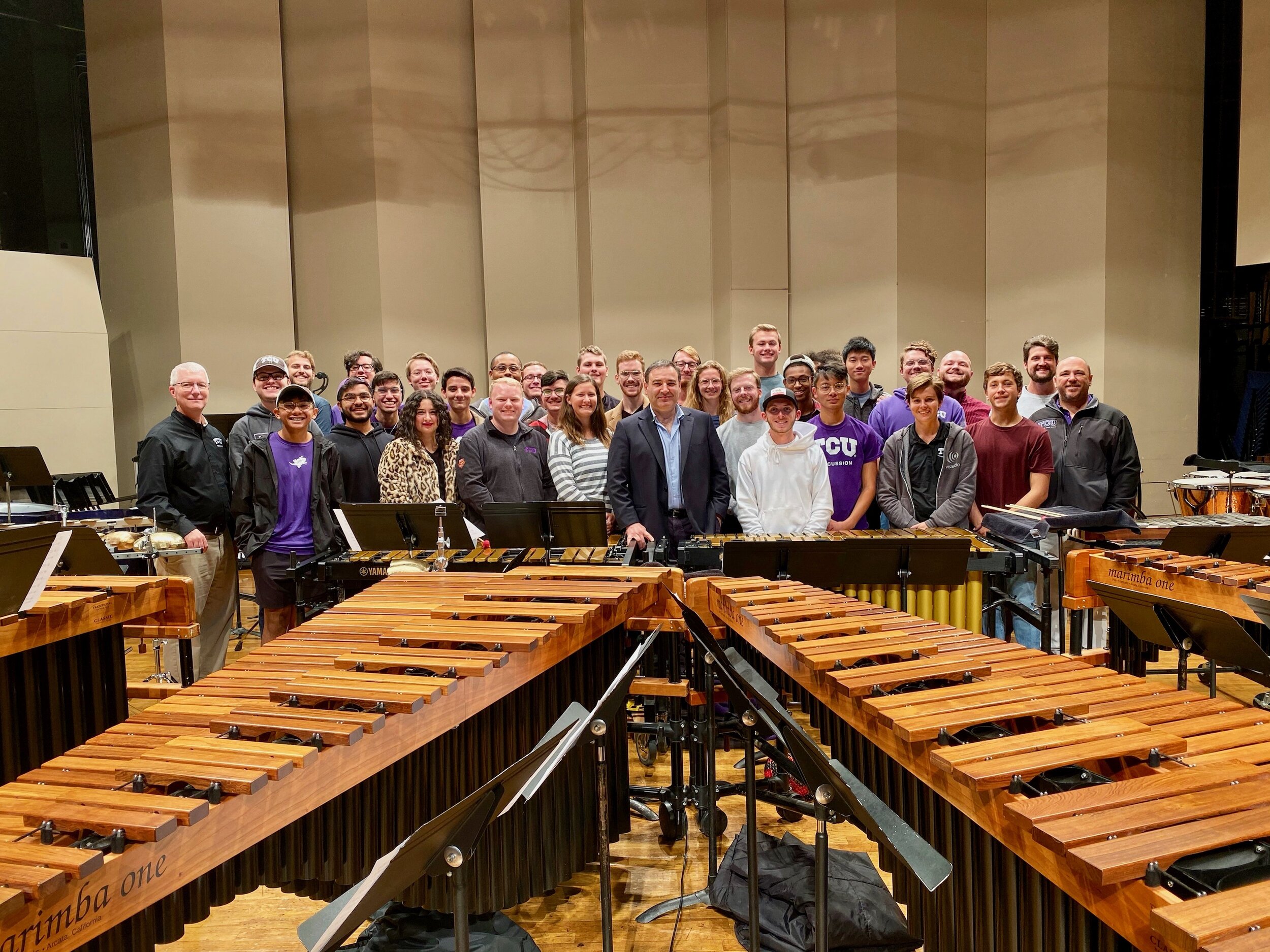
Commissioned by, and dedicated to, Brian West and the Texas Christian University Percussion Orchestra
Duration: 8:30
2026
Time To Go, for thirteen percussionists, is inspired by the idea of people moving and migrating in an unsettled world. It is difficult to be unaware of the sheer numbers of human beings trying to integrate into new cultures, how often this integration is not possible or allowed, and how circumstances force further departure and even more movement. There are sudden and violent moments in the piece that represent a kind of ‘get out of here’. The piece is about not being able to settle, but it is also about the immense new, and often positive, energies upon arrival in new lands, and the potential for the creation hybrid vigour between existing communities and new arrivals.
In the piece, the percussion ensemble sings a translation of a haiku poem by Hakurin, who died on the 3rd day of October 1897, at the age of sixty-eight. Hakurin wrote this poem as the last actof his life.
Iza yukan
Higan no kane no
Ato _ote
Higan means literally “the other shore” and as such indicates the passage from the world of illusion to that of truth
Translated and adapted to:
Well, let’s followThe bells to
The other shore
Performance Notes
The performers are encouraged to listen carefully to the Composer Demo and reproduce thegestures, sounds, and intensities of performance as closely as possible.
Notes on Stage Layout
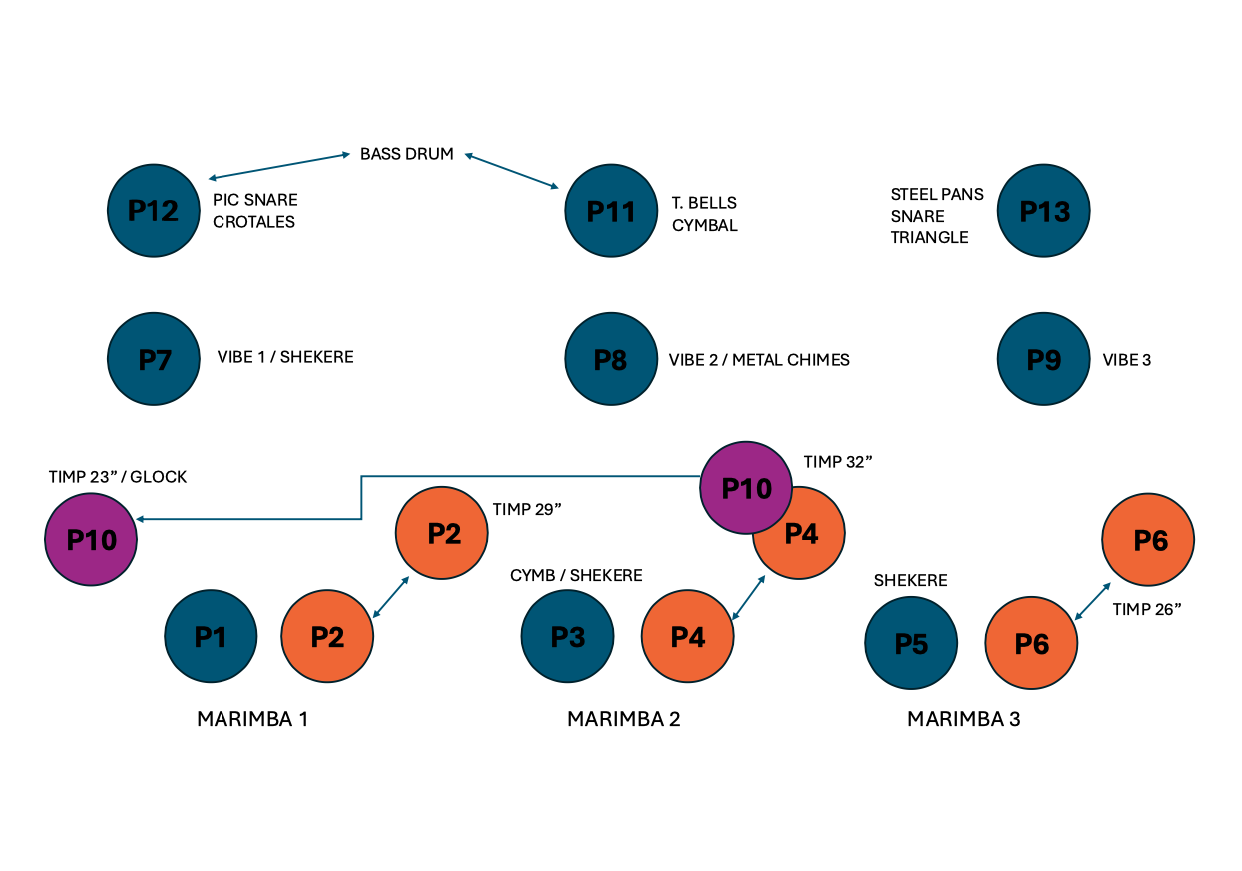
The attached diagram is a suggested stage setup. It is recommended that, if the marimbas are ona diagonal to front-of-stage, where possible the lower register of the instrument is closest to theaudience.
Complete Instrument List
3 x 5-octave Marimbas
3 x Vibraphone
4 x Timpani drums (23” / 26” / 29” /32”)
2 x suspended Cymbals (both played with wool mallets)
4 x Shekeres (mounted) - ideally with a moderate variety of sounds between instruments.
*NB Shakers are preferred over Shekere - but if balance becomes an issue try first multiple shakers in one hand. If this is not enough then mounted Shekeres should be used. The instruments (Shakers or Shekeres used by players 3,5,7,8) should sound distinct from each other.1 x Mark Tree (Metal Chimes)
1 x Glockenspiel
1 x Tubular Bells
1 x Bass Drum
1 x Piccolo Snare
1 x Concert Snare
1 x Steel Pan (double tenor): C3 / Db3 / D3 / Eb3 / E3 / F3 / F#3 / (and if possible C4 / Db4 /Eb4 / E4 - otherwise these are played down the octave)
1 x Triangle (suspended)
Instrumentation by Player
Player 1 Marimba1 / Voice (ensemble)
Player 2 Marimba1 (shared with player 1) / Timpani 29” / Voice (ensemble)
Player3 Marimba 2 / Shaker or Shekere*/ Suspended Cymbal (rolled with wool mallets) / Voice (ensemble)
Player 4 Marimba2 (shared with player 3) / Timpani 32” / Voice (ensemble)
Player 5 Marimba3 / Shaker or Shekere* / Voice (ensemble)
Player 6 Marimba3 (shared with player 5 - mallets and bow) / Timpani 26” / Voice(ensemble)
Player 7 Vibraphone1 / Shaker or Shekere* / Voice (ensemble)
Player 8 Vibraphone2 / Shaker or Shekere* / Metal Chimes (Mark Tree) / Voice(ensemble)
Player 9 Vibraphone3 (mallets and bow) / Voice (ensemble)
Player 10 Glockenspiel/ Timpani 32” (shared with player 4) / Timpani 23” / Voice(ensemble)
Player 11 TubularBells / Bass Drum / Suspended Cymbal (rolled with wool mallets) / Voice(ensemble)
Player 12 Crotales(bowed only) / Bass Drum (shared with player 11) / Piccolo snare / Voice(ensemble)
Player 13 SteelPan (double tenor) / Concert Snare / Triangle / Voice (ensemble)
NB all players are required to sing at mm155-165

Commissioned by Brian West and TCU Percussion
Listen Now
Listen Now
Gallery
Videos
Purchase this piece
Time To Go – Performance Notesfor Conductor and Players
The best guide for understanding the kind ofperformance I imagined when composing the work is to listen to the composerdemo. Creating this bar by bar is how I composed the work. The score camelater. This recording is as important as the score when preparing the work forrehearsal.
One example: in m43 the bass drum plays. Hear how thisis dynamically stronger and punchier than you might imagine by just looking atthe score. This bass drum signals both signals and triggers the beginning of anew energy in the piece, an energy that will lead us to the biggest moment. Thesame is true of the bass drum at letter E.
It’s important to get to know this composer demo welland understand the impact of each entry of new elements and how they help drivethe piece. Also listen in order to understand the layering of the elements andwhat is important at any given moment. Dynamics only go so far in clarifyingbalance and layering. The MIDI demo is a much more accurate representation ofmy conception of the piece than the score will ever be able to convey.
When timpani are playing rhythmic glissandi lines thesound needs to be punchy. Crescendi in these timpani passages (e.g. letter C)should have a strong sense of dynamic growth from start to finish so we feel apowerful momentum through each one and a strong landing at the end every time.
The first entry of these glissandi tremolo shouldintroduce a strong leveling up in energy in the performance. And eachsuccessive iteration of these rhythmic glissandi in this section should be moreintense than the previous one so they build on each other. And lead us towardthe entry of the quiet (but determined and intense) snare part.
The snare needs to have the detail in its part alwaysclearly articulated, but at the same time remain out of the way for theforegrounded materials to be heard.
At letter E the three vibraphones are creating aneffect similar to a delay pedal. For this to succeed it is crucial the dynamicsare strictly adhered to. A sectional rehearsal just for this purpose isrecommended.
The accented outbursts in the ensemble at 76-77 and 84and 85-86 are very strong. To understand how they punch out to the foregroundsuddenly each time, listen to the demo.
The measures leading into letter G represent onemusical trajectory being overwhelmed by another. The music is heading toward acadence in F# minor and should be growing toward this. Instead, it seemsto fade out and is overwhelmed by crescendo rolls in the bass drum, cymbal,snare and timpani (a wall of noise). Instead of landing in F# minor we aresuddenly in a new tonal place with a sudden upsurge in energy and momentum. Itis also important to (at least mentally) connect this moment with the parallelmoment that leads into the singing further on at letter L.
Letter H is more rhythm than anything else and it herethat piece should feel like it has, for the first time, really settled into itsgroove.
In m117 the accents on the 2nd 16ths ofbeats 1,3, & 4 should be felt as group accents and be very strong. Asshould the group accents in m118.
At letter I the conversation between the 4 timpani isvery much a combined foregrounded melody. Listen to the demo to get a feelingfor how this should be projected.
Throughout the changes in these sections, it isimportant that momentum and forward drive is never diminished.
With the introduction of the Shekere at letter J, thesound world and feel of the piece changes. If possible, find a shekere orshaker that matches what is in the demo. Also listen in the demo at how strongthe timpani accents are in this section.
At letter K note the timbre and lightness of the soundof the triangle.
A note about the singing at letter L. It is understoodthat percussionists are generally not trained singers. It is important that allinstruments being played in this section are as quiet as necessary for thesinging to be heard (particularly Player 6’s marimba and Player 4’s shekere).Ideally the ensemble would not have to sing with big voices but be able to beheard while singing in a moderate, wistful manner. As if they were on a boatfinding comfort in singing together while crossing the ocean at night. But ifthis is not possible/audible, use big voices. The tubular bells in this sectionneed to be played with very soft mallets. And Player 8’s vibes need tobe played with soft mallets. A sense of distance in these two instruments isideal.
Note in 174-180 the intensity of the timpani and bassdrum accents in the demo.
The time signature changes in 185-189 were decided bythe melody in the vibes section. It is the most user-friendly metric structureI could find.
At letter O we have arrived at the piece’s highplateau. Things will get louder from here, but by m197/letter O we have reachedthe high level of intensity and fullness of sound. This is where the performersshould be feeling ‘in their power’. And it is in this section that the smallgroups of accents (like beats 3-4 in m198) really push through to theforeground as something that is going to take over the work (and conclude it).we need to be very aware of these accents and follow their trajectory going forward.They will soon become the primary focus of the work’s trajectory at letter P.
At letter P the accented layers should be a rhythmicthunder. It is also important that we clearly hear the cross-stick on Player13’s snare as a kind of audible click track.
At letter Q we arrive at a theatrical element in thepiece. The following is extremely important. It must be explained to themusicians that there can no giveaway of the approaching outbursts. Theoutburst in m220 should make the audience jump out of their seats. There mustbe no indication that this explosion, and the subsequent shocks in m222,224, and 225 are coming.
And this is even more necessary at the very end of thepiece. The idea is to lull the audience into a false sense of security, feelingthat those violent outbursts are over, and all is well. Visually there must beno indication that anything else is coming. This is why I’ve not included thebass drum. As much as I’d like to – it would give things away if Player 11moved from the bells to the bass drum during letter S.