Omnifenix (saxophone concerto)
Overview
The orchestral materials for this work can be hired from the composer. For enquiries go to Orchestral Hires
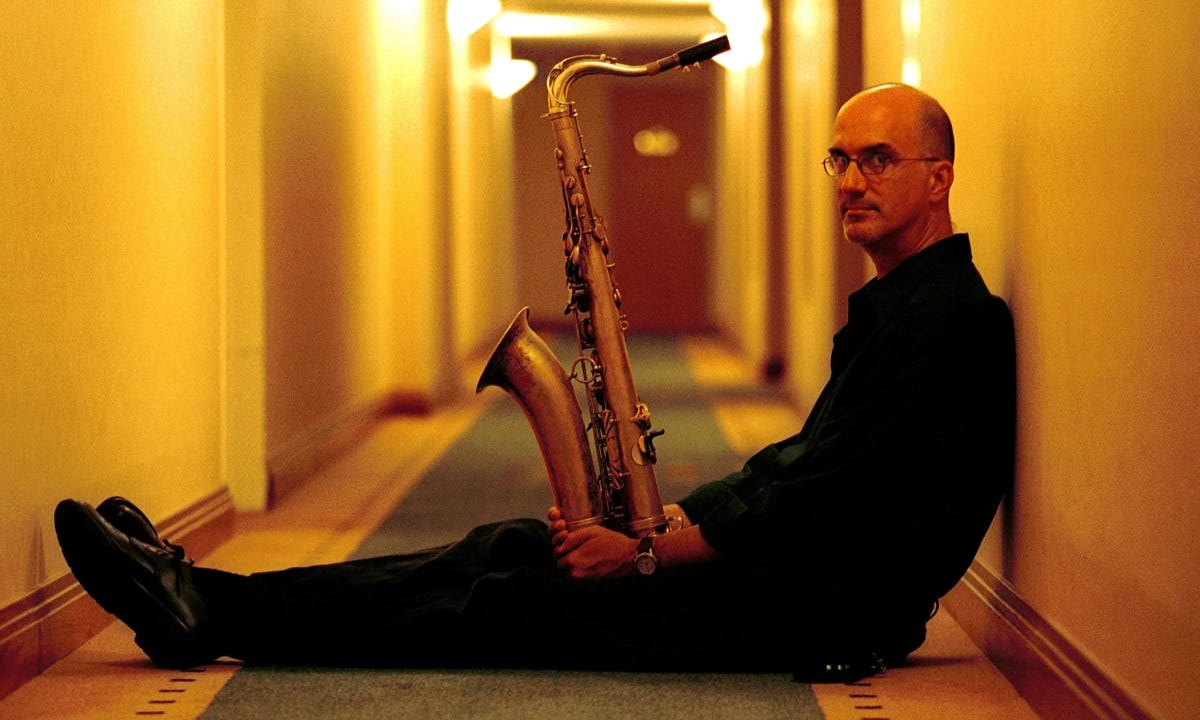
Commissioned by Concorso Internazionale "2 Agosto" in Bologna, Italy (thanks to Fabrizio Festa), Omnifenix combines directed improvisation on saxophone and drum kit with a fully-notated orchestral score. I wrote this for the legendary tenor player Michael Brecker, with the aim of creating a convincing synthesis between jazz and classical performance, where the drum set player has a double role: (1) reinforcing the orchestra's foundation (primarily through a notated kick drum line in rhythmic unison with the lower orchestral instruments) while also (2) responding to the soloist in real time. The goal was to allow the saxophone soloist enough freedom for their individuality to shine, while managing a larger symphonic structure.
Stuck in a traffic jam with Michael Brecker and Gil Goldstein, in Bologna on the way to rehearsal, I was lucky enough to have an extended conversation with these two musical icons. I asked Michael what he thought of the piece and his reply was that it disconcertingly 'fit like a glove' - I had spent many months studying his playing and improvising to gain some understanding of his improvisational uniqueness. I learnt from this that to write a work that includes an improvisor (particularly when that improvisor has a powerful standalone musical voice all their own), the work needs to be like a bespoke tailored suit, molded around the unique attributes of this particular spontaneous composer. Michael's 'glove' comment showed me such an approach can work - and in performance I heard confirmation that both the soloists and the orchestra were able to be themselves and perform from their strongest place, and yet integrate together so the elements (jazz and classical languages) were not set apart from each other. As Michael also said "the attempt at jazz-classical crossover has left a lot of musical corpses in its wake".
He also told me a joke: "Have you heard about the dyslexic Rabbi? Keeps saying 'Yo Yo Yo'...."
My strongest memory of the rehearsal and performance process of the piece coming together was this: in rehearsals Michael was seemingly lost, disinterested, and pretty vague about how it all hung together. I was devastated and it didn't seem to get any better as the rehearsals progressed. Then he walked out on stage in the performance and played the piece as if he'd written it himself. He was totally in control and did the one crucial thing I'd hoped for when writing, which was for the soloist to lead the orchestra into the big structural changes, not react to them after they'd happened. I have thought about the difference in Michael's behaviour between rehearsals and performance and I wonder if it's a case of saving it all for when the 'red light is on' (i.e. when the recording button is pressed, or when actually performing in front of an audience). Whatever the rationale, the premiere was a career-defining experience.
I also got to spend time with Gil Goldstein (winner of 5 Grammy's so far), who'd made an arrangement of Michael's Africa Skies for the same concert. This included choir and full orchestra. The African Skies original has a unique, and now famous, groove. My recollection is that the musicians in the Bologna concert were challenged by replicating this groove and Gil fought hard to keep getting them closer to it. He called me a few times when we were each recovering in our hotel rooms late at night. I remember two things he said; the first was "my least favourite question is when a musician says 'I can't feel the time - where is the time?' - what do you mean, where's the f*cking time???". And the second was about the live sound engineer - who I think was being difficult - Gil said 'sound engineers can take the job that no-one but them should be dealing with and, by not doing it well, transform it into the job that everyone has to deal with'.
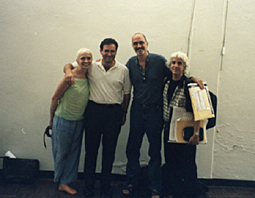
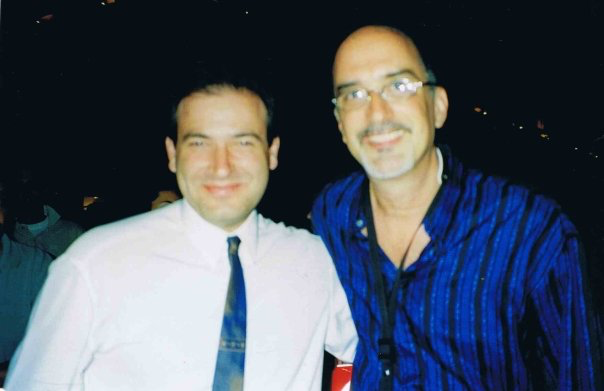
Also there was Leni Stern (partner of Mike Stern) who was incredibly lovely, and performed at the same concert. It was a gift to spend time with all of them. There's a blurry photo below.
Some 5 years later, we recorded the work with Joshua Redman, Lance Philip (drum set) and the New Zealand Symphony Orchestra conducted by Marc Taddei. This was released on Rattle Records as part of the View from Olympus album - which went on to win best classical album of the year at the New Zealand Music Awards.
Programme Note
Omnifenix is an unusual concerto in that the majority of the two soloist's parts (sacxophone and drumset) consist of instructions for directed improvisation. The title refers to jazz and classical music being “omni-genres”, sustained more by philosophies of music and culture than by any specific concepts of style. It describes a piece of music that is reborn differently each time. Like a phoenix, the improviser will continue to emerge anew and redefine the rules of their dynamic dialogue with the orchestra each time the work is performed.
The late Michael Brecker premiered Omnifenix in Bologna August 2, 2000. The Orchestra Sinfonica dell'Emilia-Romagna "Arturo Toscanini" was conducted by Marcello Rota. The solo drum set part was performed by by Massimiliano Guono.
Full Instrumentation
Tenor saxophone solo
Drum set solo
2 Flute (both dbl pic)
2 Oboe
2 Clarinet (Eb)
2 Bassoon
4 Horn
3 Trumpet
2 Trombone
Bass Trombone
Tuba
Timpani
3 Percussion
Strings

Commissioner: Concorso Internazionale “2 Agosto”, Bologna, Italy
Collaborator: Michael Brecker
Instrumentation: Tenor Saxophone & Drum Set Soli + 2(2pic).2.2(Eb).2 / 4.3.3.1 / Timp.3perc / Str
Premiered by Michael Brecker and Orchestra Sinfonica dell Emilia Romagna Toscanini with Marcello Rota (cond) on August 2, 2000 in Bologna, Italy
Listen Now
Listen Now
Gallery