Kyoto (percussion quintet)
Overview
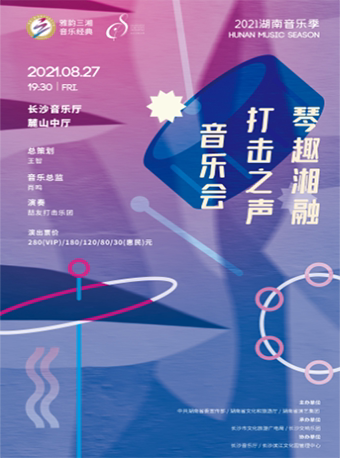
Kyoto, premiered by the Ju Percussion Group in Taiwan City on May 20, 2011, was commissioned by them for the 2011 Taipei International Percussion Convention.
As I write these notes in the last days of 2025, I'm preparing to fly to Taipei for Ju Percussion's 40th anniversary (a significant milestone for any musical ensemble), where I'll hear them present the world premiere of ...before and after love... the first of 5 new pieces I'm currently writing for this extraordinary powerhouse of global percussion.
Since it's premiere all that time ago, Kyoto has taken on a life of its own and become - along with One Study One Summary - one of my most frequently performed works internationally. I feel it has become standard teaching repertoire at universities and (increasingly) high schools around the world. One of the milestones of this piece's life is Elemental Culture's video capture - spearheaded by Svet Stoyanov - viewable on YouTube:
As in many of my works I started with a first bar of single-pitch rhythm, with no idea at all about where it might lead, and everything emerged from there.
I've found myself increasingly involved in coaching ensembles learning the work and, aside from getting into detail with the dynamic layering, I find the focus tends to be on three things:
1 Understanding and shaping the trajectory form the downbeat of bar 1 to the single cymbal crash at the start of the climax.
2 Keeping intensity high after that cymbal crash and not dropping down too soon (it's along fade out....)
3 Actually fading out to niente so that the last few measures of each part dissolve into the remaining parts
I've tried to understand what makes this piece attractive to ensembles and I've concluded it's a combination of equal distribution of interest and focus in all five parts, as well as a challenging but not virtuosic demand on the performers.
Departing from my earlier intense and physically demanding percussion compositions, such as Drum Dances and One Study One Summary, Kyoto shares more stylistic similarities with the marimba concerto Djinn.
The piece has a constant rhythmic semiquaver pulse that drives the momentum, moving through a lot of time signatures and punctuated by significant moments of silence that give rise to shifts in the harmonic terrain. The title of the work is inspired by (the first 10 minutes) of a 1976 improvisation by Keith Jarrett recorded in Kyoto, which has been one of the anchors in my musical life. When I turned 50 I went to Kyoto and visited the venue where Keith Jarrett performed this music. A pilgrimage to a holy shrine.....
Full Instrumentation
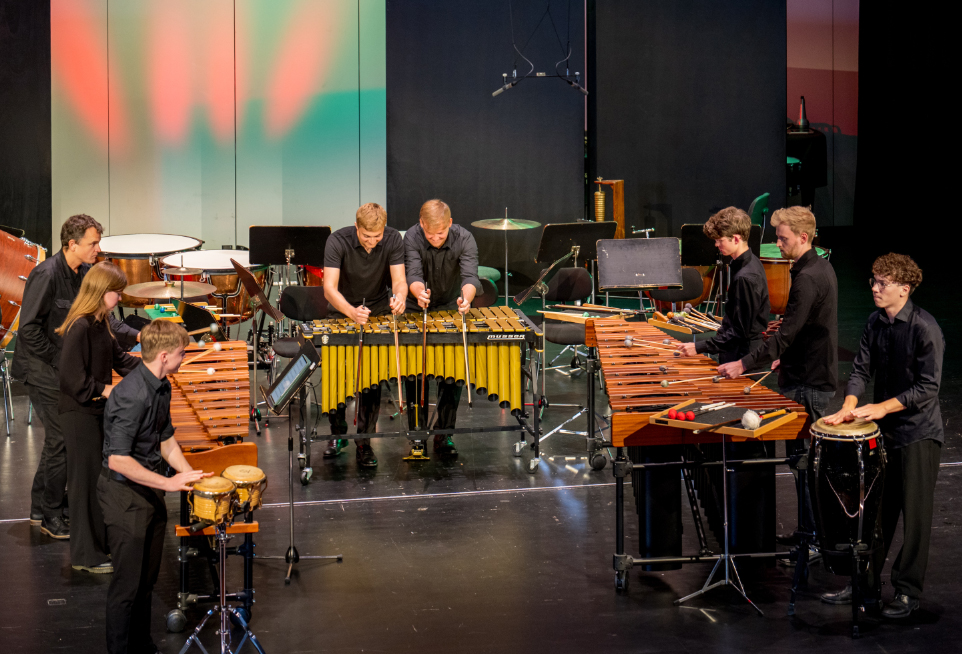
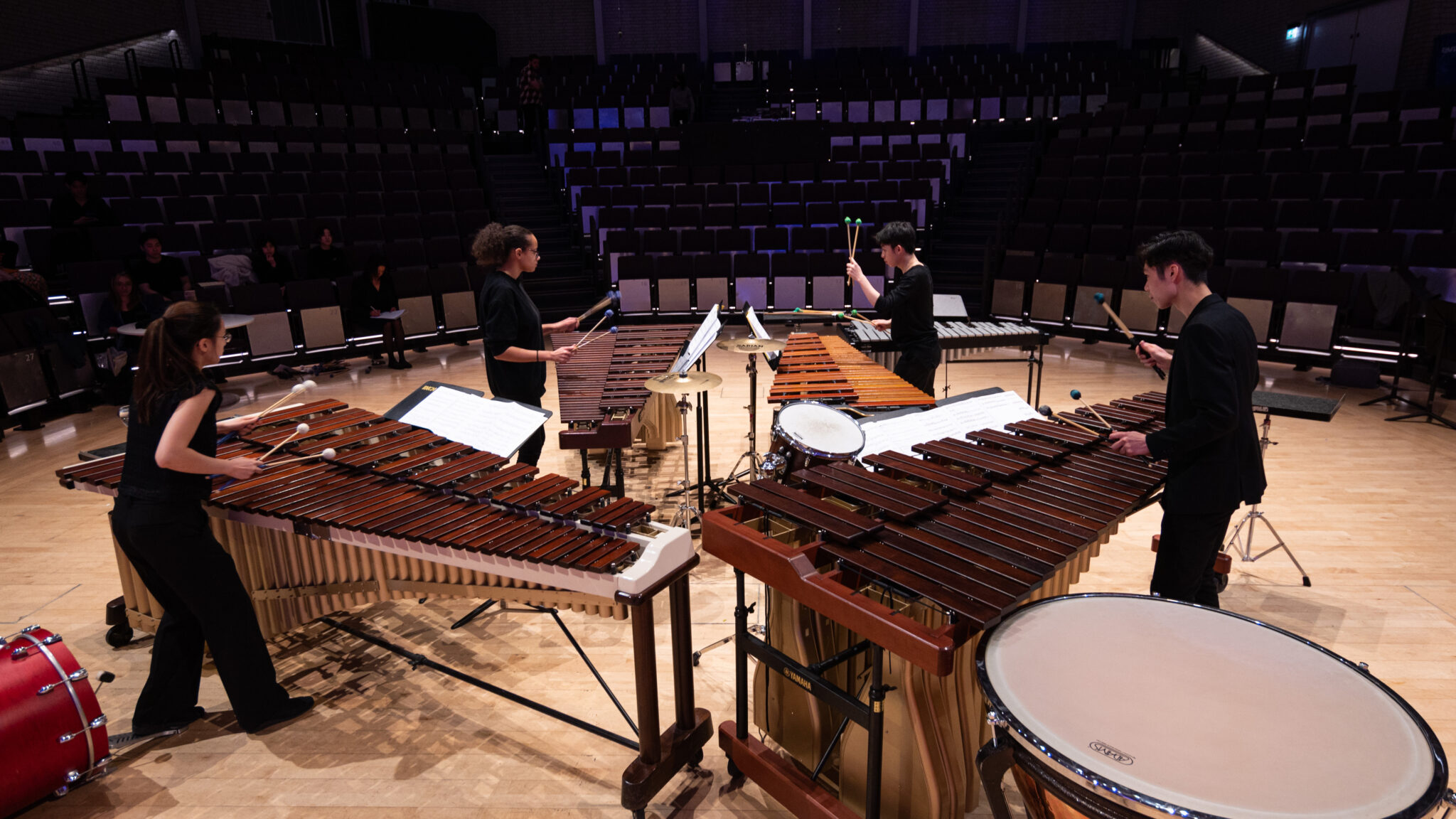
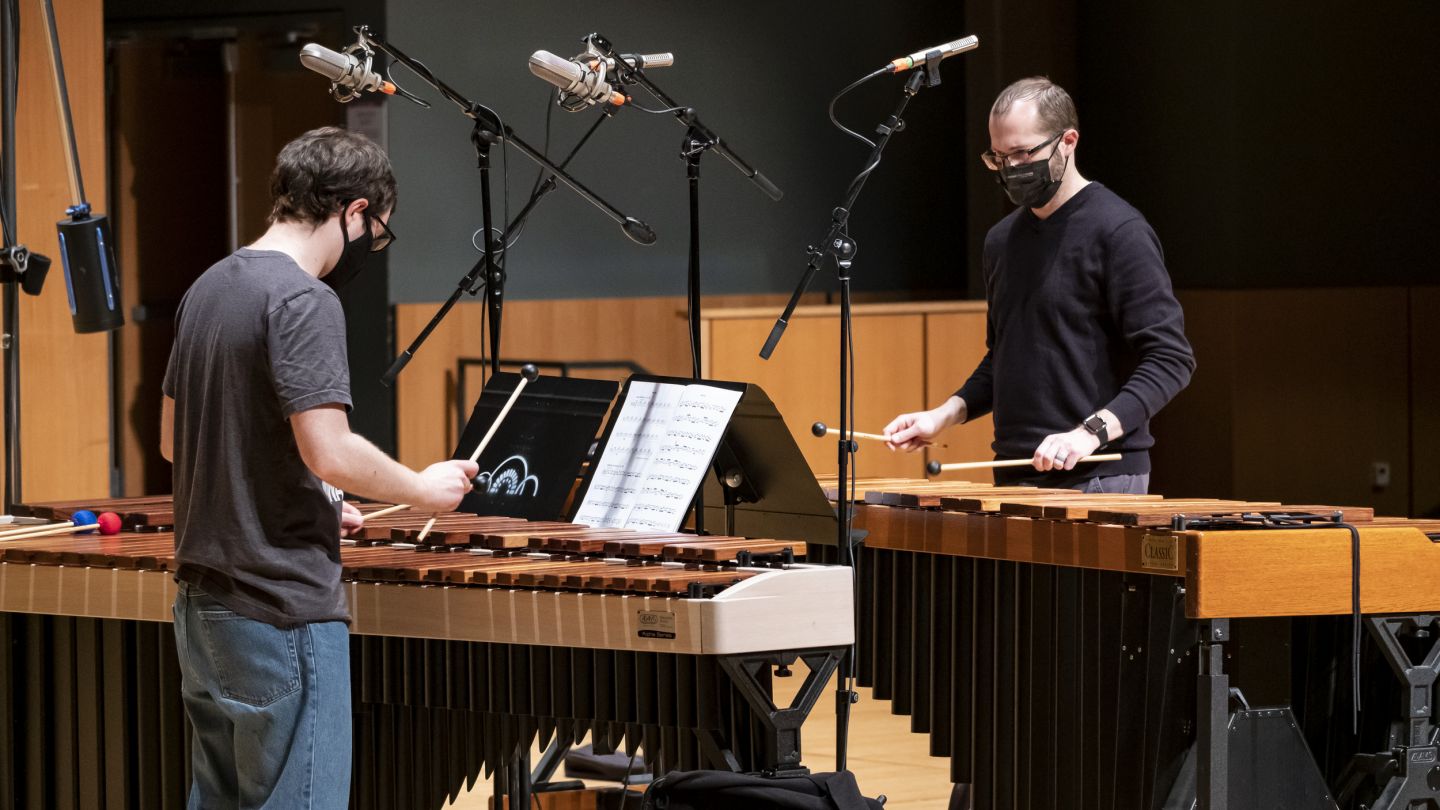
Players 1&2: 5 octave marimba (shared), or 2 marimbas
Player 3: vibraphone
Player 4: toms, suspended cymbal, triangle
Player. 5: vibraphone, glockenspiel, triangle
Performance Notes
- Notes with a cross centred on the stem indicates a deadstroke.
- Pedaling, where marked, should be followed explicitly to ensure all notes are held as specified by the laissez vibrer (l.v.) markings.
- Solo and non solo markings throughout emphasise which instrument or phrase is predominant.
Percussion 1: Vibraphone 1 (soloist role and should be positioned centrally)
Percussion 2: Vibraphone 2, Glockenspiel and Triangle
- Both vibraphones require foot switches for operating the motor.
- The glockenspiel sounds two octaves higher than written.
Percussion 3 & 4: Marimba (5-octave) shared between the two players.
- The marimba parts are designed to be performed on a single 5-octave marimba which is to be shared between two players. It is also possible to perform this work on two separate instruments. The Performance Set (PE174P) includes a combined part containing the marimba grand staff and two individual parts to accommodate both performance options.
- In Marimba Player 2 mm.33-40, the p markings only apply to the notes they are directly below.
- Marimba Player 2 requires a bow for the arco section mm.123-141. Two mallets are to be held in the left hand at this point to facilitate the playing of mm.139-140 where a lateral roll is required concurrently with a bowed note.
Percussion 5: 3 Tom-toms, Splash Cymbal, Triangle

Commissioner: Ju Percussion Group
Instrumentation: Vib, Vib/Gloc/Tri, Mar, Toms/Spash/Tri
Premiered by Ju Percussion Group on May 20, 2011 at the Taiwan City, Taiwan (R.O.C)